When purchasing stepper motor drivers, also called controllers, several factors must be taken into consideration. Buyers should make sure that the motor is compatible with the driver, as there are several different types. The number of wires in the motor determines whether a bipolar or unipolar driver is required. Maximum current input and output of the motor also impact which servo driver to purchase, as do features such as step modes, step frequency, and protection circuitry. There are numerous types of stepper drives available, each with advantages and disadvantages. Choosing the right kind of driver depends on the type of task the stepper motor will be applied to, as well as the step mode requirements. Here recommend you Brand stepper drive by Fasttobuy.com.
The Leadshine Stepper drive's performance comes from its powerful 32-bit DSP processor and associated control algorithms. These achieve smooth performance at low speeds by significantly minimising fluctuations from the desired motor speed. The Leadshine stepper drive can also calculate the natural system frequency and apply a damping function to eliminate resonance. This yields higher speed and better motor performance; it also optimises torque and eliminates mid-range instability. And by cutting stepper motor heating losses, the driver brings energy saving benefits, together with reduced maintenance costs.
System set-up is said to be fast and simple due to the motor auto-tuning and parameter auto-configuration technology. This allows automatic compensation for the unique characteristics of any motor connected to the drive. The motor can be sized from NEMA 17 to NEMA 34 diameter due to wide input voltage coverage and a programmable output current range from 0.5-5.6A. Either two- or four-phase motors can be connected. The drive has a programmable resolution, from full step to 102,400 steps per resolution. The stepper driver's Multistep function allows this full microstepping resolution to be applied to a standard 200-step motor, so system performance becomes smoother.
Highlights
Suitable to drive size NEMA 17 to NEMA 34 stepper motors
Supply voltage up to +50VDC
Programmable output current range from 0.5-5.6A
Programmable resolution from full step to 102,400 micro steps per resolution
Support PUL/DIR and CW/CCW modes
Over-voltage, over-current and phase-error protection provided as standard
Stepper drives always offer the cheapest solution, so use a stepper wherever appropriate. Remember these major considerations: First, does the system require position confirmation? Second: The wrong stepper drive can cause ringing, resonance, and poor low-speed performance. Third, during high speeds, stepper motors can whine. Because stepper drives have a high pole count, hysteresis and eddy current losses are also common at high speed; for these reasons, a stepper is not recommended for continuous operation above 2,000 rpm. Finally, because full current is needed to produce holding torque, step motors can get hot at a standstill.
Fasttobuy has a large selection stepper drives and controls, available in both new and used condition, and the price range varies significantly across the range.
This is the blog about industry automation, where is original research and aggregation of content about Industrial automation control system and other industry devices, motor, accessories, CNC solution, etc.
2016年4月19日星期二
2015年5月22日星期五
3-D Printing Will Change the World
- Richard A. D’Aveni
-
To anyone who hasn’t seen it demonstrated, 3-D printing sounds futuristic—like the meals that materialized in the Jetsons’ oven at the touch of a keypad. But the technology is quite straightforward: It is a small evolutionary step from spraying toner on paper to putting down layers of something more substantial (such as plastic resin) until the layers add up to an object. And yet, by enabling a machine to produce objects of any shape, on the spot and as needed, 3-D printing really is ushering in a new era.
As applications of the technology expand and prices drop, the first big implication is that more goods will be manufactured at or close to their point of purchase or consumption. This might even mean household-level production of some things. (You’ll pay for raw materials and the IP—the software files for any designs you can’t find free on the web.) Short of that, many goods that have relied on the scale efficiencies of large, centralized plants will be produced locally. Even if the per-unit production cost is higher, it will be more than offset by the elimination of shipping and of buffer inventories. Whereas cars today are made by just a few hundred factories around the world, they might one day be made in every metropolitan area. Parts could be made at dealerships and repair shops, and assembly plants could eliminate the need for supply chain management by making components as needed.
Another implication is that goods will be infinitely more customized, because altering them won’t require retooling, only tweaking the instructions in the software. Creativity in meeting individuals’ needs will come to the fore, just as quality control did in the age of rolling out sameness.
These first-order implications will cause businesses all along the supply, manufacturing, and retailing chains to rethink their strategies and operations. And a second-order implication will have even greater impact. As 3-D printing takes hold, the factors that have made China the workshop of the world will lose much of their force.
China won’t be a loser in the new era, but it will have to give up on being the world’s manufacturing powerhouse.
China has grabbed outsourced-manufacturing contracts from every mature economy by pushing the mass-manufacturing model to its limit. It not only aggregates enough demand to create unprecedented efficiencies of scale but also minimizes a key cost: labor. Chinese government interventions have been pro-producer at every turn, favoring the growth of the country’s manufacturers over the purchasing power and living standards of its consumers.
Under a model of widely distributed, highly flexible, small-scale manufacturing, these daunting advantages become liabilities. No workforce can be paid little enough to make up for the cost of shipping across oceans. And few managers raised in a pro-producer climate have the consumer instincts to compete on customization.
It seems that the United States and other Western countries, almost in spite of themselves, will pull off the old judo technique of exploiting a competitor’s lack of balance and making its own massive weight instrumental in its fall.
China won’t be a loser in the new era; like every nation, it will have a domestic market to serve on a local basis, and its domestic market is huge. And not all products lend themselves to 3-D printing. But China will have to give up on being the mass-manufacturing powerhouse of the world. The strategy that has given it such political heft won’t serve it in the future.
The great transfer of wealth and jobs to the East over the past two decades may have seemed a decisive tipping point. But this new technology will change again how the world leans.
A version of this article appeared in the March 2013 issue of Harvard Business Review.
To anyone who hasn’t seen it demonstrated, 3-D printing sounds futuristic—like the meals that materialized in the Jetsons’ oven at the touch of a keypad. But the technology is quite straightforward: It is a small evolutionary step from spraying toner on paper to putting down layers of something more substantial (such as plastic resin) until the layers add up to an object. And yet, by enabling a machine to produce objects of any shape, on the spot and as needed, 3-D printing really is ushering in a new era.
As applications of the technology expand and prices drop, the first big implication is that more goods will be manufactured at or close to their point of purchase or consumption. This might even mean household-level production of some things. (You’ll pay for raw materials and the IP—the software files for any designs you can’t find free on the web.) Short of that, many goods that have relied on the scale efficiencies of large, centralized plants will be produced locally. Even if the per-unit production cost is higher, it will be more than offset by the elimination of shipping and of buffer inventories. Whereas cars today are made by just a few hundred factories around the world, they might one day be made in every metropolitan area. Parts could be made at dealerships and repair shops, and assembly plants could eliminate the need for supply chain management by making components as needed.
Another implication is that goods will be infinitely more customized, because altering them won’t require retooling, only tweaking the instructions in the software. Creativity in meeting individuals’ needs will come to the fore, just as quality control did in the age of rolling out sameness.
These first-order implications will cause businesses all along the supply, manufacturing, and retailing chains to rethink their strategies and operations. And a second-order implication will have even greater impact. As 3-D printing takes hold, the factors that have made China the workshop of the world will lose much of their force.
China won’t be a loser in the new era, but it will have to give up on being the world’s manufacturing powerhouse.
China has grabbed outsourced-manufacturing contracts from every mature economy by pushing the mass-manufacturing model to its limit. It not only aggregates enough demand to create unprecedented efficiencies of scale but also minimizes a key cost: labor. Chinese government interventions have been pro-producer at every turn, favoring the growth of the country’s manufacturers over the purchasing power and living standards of its consumers.
Under a model of widely distributed, highly flexible, small-scale manufacturing, these daunting advantages become liabilities. No workforce can be paid little enough to make up for the cost of shipping across oceans. And few managers raised in a pro-producer climate have the consumer instincts to compete on customization.
It seems that the United States and other Western countries, almost in spite of themselves, will pull off the old judo technique of exploiting a competitor’s lack of balance and making its own massive weight instrumental in its fall.
China won’t be a loser in the new era; like every nation, it will have a domestic market to serve on a local basis, and its domestic market is huge. And not all products lend themselves to 3-D printing. But China will have to give up on being the mass-manufacturing powerhouse of the world. The strategy that has given it such political heft won’t serve it in the future.
The great transfer of wealth and jobs to the East over the past two decades may have seemed a decisive tipping point. But this new technology will change again how the world leans.
A version of this article appeared in the March 2013 issue of Harvard Business Review.
2015年5月21日星期四
XINJE HMI THA62-UT 10.1 Inch 800*480
Product description
More Infomation THA62-UT: https://www.fasttobuy.com/hmi-101-800480-128mb-usb-port-tha62ut-with-programming-cable-new_p25802.html
| 10.1 inch touch screen, streamline design 65536 true colors display, support BMP, JPEG format pictures Rich 3D picture library can make the screen more vividly Flexible component selection space, self-defined animation track design Simple switch setting for changing the modes, precise touch area adjust function Self-defined data collection and save function Support various data process modes, such as time trend map, XY trend map… 2 USB ports can realize data duplication and transferring Two com ports can communication independently and realize multi-THs communicate with one PLC. Type notes: MT: standard UT: with USB-A port Specifications:
|
|||||||||||||||||||||||||||||||||||||||||||||||||||||||||||||||||||||
2015年5月14日星期四
Typical circuit diagram of Star Delta starter
S0 = ‘OFF’ Push button
S1 = ‘ON’ Push button
K1 = Line contactor
K2 = Star contactor
K3 = Delta contactor
K4 = Star delta timer (7PU60 20)
F2 = Overload relay
F1 = Backup fuse
F3 = Control circuit fuse
This is a starting method that reduces the starting current and starting torque. The device normally consists of three contactors, an overload relay and a timer for setting the time in the star-position (starting position). The motor must be delta connected during a normal run, in order to be able to use this starting method. The received starting current is about 30% of the starting current during direct on line start and the starting torque is reduced to about 25 % of the torque available at a D.O.L start. This starting method only works when the application is light loaded during the start. If the motor is too heavily loaded, there will not be enough torque to accelerate the motor up to speed before switching over to the delta position. When starting up pumps and fans for example, the load torque is low at the beginning of the start and increases with the square of the speed. When reaching approx. 80-85% of the motor rated speed the load torque is equal to the motor torque and the acceleration ceases. To reach the rated speed, a switch over to delta position is necessary, and this will very often result in high transmission and current peaks. In some cases the current peak can reach a value that is even bigger than for a D.O.L start. Applications with a load torque higher than 50 % of the motor rated torque will not be able to start using the start-delta starter.S1 = ‘ON’ Push button
K1 = Line contactor
K2 = Star contactor
K3 = Delta contactor
K4 = Star delta timer (7PU60 20)
F2 = Overload relay
F1 = Backup fuse
F3 = Control circuit fuse
Wiring of Star Delta Starter with Timer Control Panel
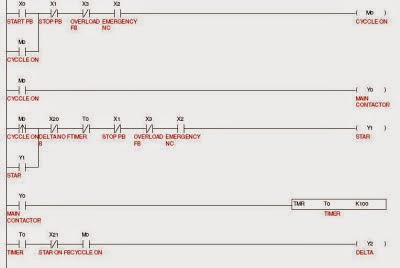
PLC Program for Star Delta Starter
2015年5月8日星期五
3D COMPUTER AIDED DESIGN AND MANUFACTURE
3D Design software such as Pro/DESKTOP® allows the designer to produce three dimensional representations of his/her ideas. When completed the design can be viewed on the screen and it can even be revolved and examined at any angle. 3D software such as Pro/DESKTOP® is much more complex than 2D software such as TechSoft 2D design. It requires specialist training before it can be used competently.
1. The designer draws up the design using software such as Pro/DESKTOP®. The design can be examined in detailed and if modifications/alterations are needed they can be made on the screen.Software of this type allows the designer to model his/her idea on the screen rather than make/manufacture an expensive model. Good 3D software allows the designer to design almost any item.
2. The design is processed. When the design has been completed using Pro/DESKTOP® it must be exported as a stereo lithography file. This type of file can be imported into processing software such as Boxford’s 3D-GeoCAM which converts the drawing into a long list of coordinates. Each set of coordinates is called a GM code.
3. Most CAD/CAM software allows the designer to test the manufacture of his/her design on a computer rather than actually making it. This saves time and materials. Testing designs is carried out using ‘simulation’ software. When the design is run through simulation software the computer displays the manufacturing on the screen. It also checks whether or not the design can be manufactured successfully. Many designs have to be altered before they can be made by a CNC machine.
4. An advanced CNC machine such as the A3 HSRi² (Boxford Machine Tools, Halifax, England)
can be used to manufacture the three dimensional product. This CNC is both fast and accurate
making suitable for school and industrial use.
| ||
2015年5月6日星期三
New Kinco HMI MT4414TE-CAN USB Host Ethernet with Software
MT4000 series HMI use 32-bit RISC
CPU and streamlined LINUX kernel, you can display a variety of
true-color graphics format, and its superior processing speed and
software to meet the needs of most users. Support and the vast majority
of the PLC to communicate directly, and can easily exchange data between
their connected devices. MT4000 series has a direct line simulation,
indirect line simulation, high-capacity user configuration program
memory space, compatible with the standard C language macro functions
fit the customer needs quickly and effectively complete the field data
collection, computing, control.
Features:
(1)65536 color TFT display, supports BMP, JPG, GIF, and other format images import;
(2)High-performance 32-bit 400MHz RISC CPU, fast processing capability to protect the higher work efficiency;
(3)4.3 "to 12.1" wide range of display size;
(4)MT4000E configuration 10M/100M adaptive Ethernet interface;
(5)The integration 1USB the Slave and a DB15/DB25 printer interface;
(6)A powerful the EV5000 configuration software function to support the C language macro script;
Specifications:
MT4414TE-CAN
Display: 7” 16:9 TFT
Color: 65536 Colors
Memory: 128M FLASH + 64M SDRAM
All Kinco series products use HMI configuration editing software (official version): _Kinco HMI software_V2.2_Build131108 (Automatically install driver)
MT4000 series HMI adopts 32 bits RISC CPU and LINUX inner core
MT5000 series HMI adopts powerful intel PXA270 520MHz processor and high-efficiency LINUX system
Human Interface: CE Certification(including MT6000,MT5000,MT4000,MT500 and Text series)
Language: English
More info View here:
http://www.fasttobuy.com/7-hmi-800480-mt4414tecan-usb-host-ethernet-with-free-programming-cablesoftware-new_p26929.html
Features:
(1)65536 color TFT display, supports BMP, JPG, GIF, and other format images import;
(2)High-performance 32-bit 400MHz RISC CPU, fast processing capability to protect the higher work efficiency;
(3)4.3 "to 12.1" wide range of display size;
(4)MT4000E configuration 10M/100M adaptive Ethernet interface;
(5)The integration 1USB the Slave and a DB15/DB25 printer interface;
(6)A powerful the EV5000 configuration software function to support the C language macro script;
Specifications:
MT4414TE-CAN
Display: 7” 16:9 TFT
Color: 65536 Colors
Memory: 128M FLASH + 64M SDRAM
|
Model |
MT4414T |
MT4414TE |
MT4414TE-CAN |
|
Performance specification |
|||
|
Display |
7" 16:9 TFT |
||
|
Resolution |
800*480 |
||
|
Color |
65536 |
||
|
Backlight |
LED |
||
|
Brightness |
300cd/m2 |
||
|
Backlight life |
50000 hours |
||
|
Touch Panel |
4-wire precision resistance network |
||
|
Processor |
32-bit 400MHz RISC |
32-bit 800MHz RISC |
|
|
Memory |
128M FLASH + 64M SDRAM |
||
|
U Disk |
None |
1 USB host |
|
|
SD Card |
None |
||
|
Recipe memory & RTC |
512KB + RTC |
||
|
Printer port |
Serial port |
Serial port/USB port |
|
|
Ethernet |
None |
Support |
|
|
Program download |
USB SLAVE/Serial port |
USB SLAVE/Serial port/Ethernet port |
|
|
COM port |
COM0:RS232/RS485-2/RS485-4,COM2:RS232 |
||
|
Expansion Port |
None |
CANopen |
|
|
Software |
EV5000 V1.6 |
||
|
Electrical specification |
|||
|
Rated power |
4W |
||
|
Rated voltage |
DC24V |
||
|
Input range |
12~28VDC |
||
|
Power down allowed |
<3ms |
||
|
Insulation resistance |
Greater than 50MΩ@ 500V DC |
||
|
Dielectric strength test |
500 VAC 1 minute |
||
|
Structure specification |
|||
|
Shell color |
Black |
||
|
Shell material |
ABS |
||
|
Dimensions(mm) |
204×150×37mm |
||
|
Cutout size(mm) |
192×138mm |
||
|
Weight |
0.75 Kg |
||
|
Environment specification |
|||
|
Operating temperature |
0~45 °C |
||
|
Operating humidity |
10~90% non-condensing |
||
|
Storage temperature |
-10~60 °C |
||
|
Storage humidity |
10~90% non-condensing |
||
|
Shockproof test |
10~25Hz (X, Y, Z direction, 2G, 30 minutes) |
||
|
Cooling method |
Natural air cooling |
||
|
Certification |
|||
|
Degree of protection |
IP65 (front panel) |
||
|
CE certification |
Comply with EN61000-6-2:2005 and EN61000-6-4:2007standards |
||
|
FCC compatibility |
Complies with FCC Class A |
||
All Kinco series products use HMI configuration editing software (official version): _Kinco HMI software_V2.2_Build131108 (Automatically install driver)
MT4000 series HMI adopts 32 bits RISC CPU and LINUX inner core
MT5000 series HMI adopts powerful intel PXA270 520MHz processor and high-efficiency LINUX system
Human Interface: CE Certification(including MT6000,MT5000,MT4000,MT500 and Text series)
Language: English
More info View here:
http://www.fasttobuy.com/7-hmi-800480-mt4414tecan-usb-host-ethernet-with-free-programming-cablesoftware-new_p26929.html
订阅:
博文 (Atom)