2016年5月13日星期五

Step Motor Excitation Modes

Stepper motor drivers often have different modes of operation. These different modes determine in what sequence the coils are energized to make the motor shaft move appropriately. There are four types of these stepping modes. However, only three of the excitation modes are common in most stepper drivers.

Full-step excitation

In full step operation, the motor step through the normal step angle e.g.200 step/revolution motors take 1.8" steps while in half step operation, 0.9" step are taken. There are two kinds of full-step modes. Single phase full-step excitaion is where the motor is operated with only one phase energized at-a-time. This mode should only be used where torque and speed performance are not important, e.g. where the motor is operated at a fixed speed and load conditions are well defined. Problems with resonance can preclude operation at some speeds. This mode requries the least amount of power from the drive power supply of any of the excitation modes. Dual phase full-step excitation is where the motor is operated with two phases energized at-a-time. This mode provides good torque and speed performance with a minimum of resonance problems. Dual excitation, provides about 30 to 40 percent more torque than single excitation, but does require twice the power from the drive power supply.


Half-step excitation

The Half step mode energizes a single coil then two coils then one again. Alternating between energizing a single phase and both phases together gives the motor its higher resolution. A 200 step Step motor driver operating in half step mode would have 400 positions, twice the normal resolution. However, the torque will vary depending on the step position because at times a single phase will be energizes while at other times both phases will be energized. Higher end drivers compensate by increasing the current through the single coil when a single coil is energized. This makes up for the loss in torque, making the half step mode very stable.

Half step excitation is alternating single and dual phase operation resulting in steps that are half the basic step angle. Due to the smaller step angle, this mode provides twice the resolution and smoother operation. Half stepping produces roughly 15% less torque than dual phase full stepping. Modified half stepping eliminates this torque decrease by increasing the current applied to the motor when a single phase is energized.

Micro-step drive

In the micro-step mode, a motor's natural step angle can be divided into much smaller angles. For example, a standard 1.8" degree motor has 200 steps/revolution. If the motor is micro-stepped with a "divide-by-10"). The micro-steps are produced by proportioning the current in the two windings according to sine and cosine functions. This mode is only used where smoother motion or more resolution is required.

It is important to take into consideration the step modes and how best to utilize them when designing the CNC router drive system. It is also very important when choosing a stepper motor driver. Some drivers will micro-step more smoothly than others. In the next section we will cover the ins and outs of buying a stepper driver and what features to look for.

We Fasttobuy Co.,Ltd is a professional manufacturer of automation control. Currently, our company specialized in the production of linear actuator, hybrid stepper motor, screw and nut.For more details, please feel free to contact us!

2016年5月10日星期二

Types of Servo Motors

Servo motors are widely used to control motion in a variety of electro-mechanical industries, from robotics to CNC manufacturing to aerospace technology. Servo motors are part of a closed-loop system, known as a servo motor system, that doesn't use a stepper motor. Servo motor systems consist of several parts namely a control circuit, servo motor, shaft, potentiometer, drive gears (depending on the type of servomotor), amplifier and either an endocer or resolver. Servo motors must have the ability to:

operate at a variety of speeds without overheating;
operate at zero speed while retaining enough torque to hold a load in position; and
operate a very low speeds for long periods witho ut overheating.
The three basic types of servo motors utilized in servo motor systems are:
AC servo motors (based on induction motor designs);
DC servo motors (based on direct current motor designs); and
Brushless servo motors (based on synchronous motor designs).

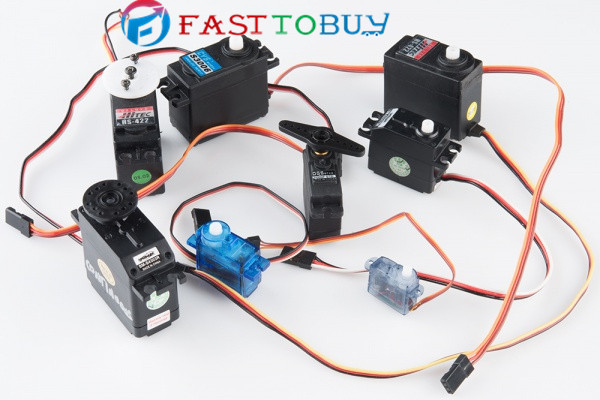
servo-samples

Brushless motors are similar to AC servo motor since a moving magnet field causes rotormovement.Brushless motors are also similar to PM DC motors since they have predicable linear characteristics.

Is this why the brushless is sometimes called AC brushless and sometimes called DC brushless? It is the method of driving or powering the motor from which the name AC or DC is derived. The method of driving the motor can result in different effects (i.e. different torque delivered even from the same motor!).

Where are Servo Motors used?

Servos are extremely useful in robotics and automation. Servo motors are used across various automation fields specifically where the motor must be able to operate at a range of speeds without overheating, operate at zero speed while being able to retain its load in a set position, as well as operate at low speeds. Servo motors are utilized in industrial machine tools, CNC manufacturing machines and processes, and packaging applications. Robots utilize servo motors because of their smooth commutation and accurate positioning. The aerospace industry makes use of servo motors in their hydraulic systems to contain system hydraulic fluid. The servo motor is relatively small in size, yet very powerful. A servo motor also draws power proportional to the mechanical load.

What Industries are Servo Motors used in?

Servo motors are seen in applications such as factory automation, robotics, CNC machinery, and packaging. The feedback lets the drive know its position, speed, and torque to detect unwanted motion. Pharmaceutical industries are driven by the need to create smaller devices; ones that are easier to operate and function more efficiently.

Fasttobuy offer a wide range of brushless AC and DC motors giving choices on:

torque / speed
operating voltage
feedback devices
inertia levels
cooling options

We also offer a wide range of associated components such as gearboxes, shaft couplings, holding brakes, cable sets, temperature sensors. Please give us a call to discuss your requirements.

2016年5月5日星期四

Induction-type AC Servo Motor

The structure of an induction-type ac servo motor is identical with that of a general induction motor. If multi-phase alternating current flows through the coil of a stator, a current is induced in the coil of rotor and the induction current generates torque. In this type of AC servo motor, the stator consists of a frame, a stator core, an armature coil, and lead wire. The rotor consists of a shaft and the rotor core that is built with a conductor.

An induction-type AC servo motor has a simple structure and does not need the detector of relative position between the rotor and stator. However, because the field current should flow continuously during stopping, a loss of heating occurs and dynamic braking is impossible, unlike the AC servo motor.

Leashine ACM Series Products

The ACM series low-medium voltage AC servo motors offer high performance with models ranging from 100W to 400W. Standard  models come  with  a  standard  2500-line  or  1000-line  differential  encoder with index slits  (A, B, Z), and Hall Sensors (U, V, W). When driven by Leadshine ACS series servo drives, the ACM series motors meet application requirements from as low as 1 rpm to as high as 4500 rpm.
  • Brushless construction
  • Reliable industrial quality
  • High torque density
  • Resolution of the integrated encoders optional
  • Metric 60 mm frame sizes
  • Rated power from 100 W to 400 W
  • Standard cabling options for direct connection to the ACS series drives
The strengths, weaknesses and characteristics of the servo motors mentioned above are summarized in Figure 1.


The rotor also has laminations; radial slots around the laminations contain the bars. As mentioned, the rotor turns when the moving magnetic field induces current in the shorted conductors, and the rate at which it rotates is the motor’s synchronous speed — determined by power-supply frequency and the number of stator poles.

Synchronous speed is the fastest theoretical speed a motor can possibly spin — when the rotor spins at the same speed as the motor’s internal rotating magnetic field. In practice, an AC induction motor is an asynchronous motor (in which the rotor lags field speed) so its rotor must spin more slowly than the field, or slip. This allows the induction of rotor current to flow, and production of torque to drive attached load while overcoming internal losses.

Induction type ac servo motors are available in fractional and integral horsepower sizes.

2016年5月3日星期二

The Difference Between Servo and Stepper Motors

Servo and stepper motors have similar construction and share the same fundamental operating principle. Both motor types incorporate a rotor with permanent magnets and a stator with coiled windings, and both are operated by energizing, or applying a dc voltage to, the stator windings, which causes the rotor to move. However, this is where the similarities between servo and stepper motors end. The following will compare the differences between Stepper and Servo Motors, and when each technology is most appropriate for use in specific applications.

Closed-Loop vs. Open-Loop:

Stepper Motors are generally operated under open-loop control. Commands determine the specified movement of the Stepper Motor. In rare instances, Stepper Motors can stall or lose steps, due to resonance issues or unexpected force. While it is a rare occurrence, the possibility is a drawback for Stepper Motor technology. Stepper Motors can operate in a closed-loop configuration. However, this results in a costly system design.


A servo motor, on the other hand, runs on a closed-loop control. Although the servo also receives a command signal from its controller, just like a stepper does, the key difference is the servo motor has an onboard encoder that continuously communicates back to the controller. As it communicates, the servo motor is updating its position, communicating back its progress, and ultimately verifying that the final target position has been achieved.

A closed-loop stepper motor system, such as the HBS86 stepper motor drivers, may be the best option when the application requires improved energy efficiency and smoothness of operation, especially at high loads.

The HBS series offers an alternative for applications requiring high performance and high reliability when the servo was the only choice, while it remains cost-effective. The system includes a 2-phase stepper motor combined with a fully digital, high performance drive and an internal encoder which is used to close the position, velocity and current loops in real time, just like servo systems.

Feature

30-80V, 8.2A Peak, No Tuning, Nulls loss of Synchronization
Closed-loop, eliminates loss of synchronization
Broader operating range – higher torque and higher speed
Reduced motor heating and more efficient
Smooth motion and super-low motor noise
Do not need a high torque margin
No Tuning and always stable
High torque at starting and low speed, high stiffness at standstill
Lower cost

Speed and Power:

At high speeds, Stepper Motors typically have poor torque characteristics. Through microstepping, torque can be improved. However, unless Stepper Motors are used in closed-loop mode, they do not perform as well as Servo Motors.

Comparing similar sizes, Servo Motors can generate speeds and power anywhere between two and four times the speed of a Stepper Motor. Servo Motors operate under constant position  feedback (closed-loop), allowing for higher speed and greater reliability. Servo Motors perform under a closed-loop system, allowing the Servo Motor to attain higher peak torque capabilities.

Required Maintenance and Reliability:


Stepper Motors are brushless so they are not prone to wear and require no maintenance.

Servo Motors are available in brush-type or brushless options. Similar to steppers, brushless Servo Motors do not require maintenance. However, brush-type Servo Motors generally require a change of brushes every 5,000 hours. 

Accuracy and Resolution:


Stepper Motors generally produce 200 full steps, 400 half steps, and up to 25,000 microsteps per revolution. The specified location is not always achieved, due to the Stepper Motor’s open-loop nature, especially when operating under a load. To attain a smooth motion,microstepping is often used; however, it often results in less positional accuracy.

Servo Motor resolution is dependent upon the type of encoder used. Most encoders produce between 2,000 and 4,000 pulses per revolution, while some can produce up to 10,000 pulses  per revolution. nema 23 stepper motors can maintain positional accuracy due to their closed-loop operation.

2016年4月26日星期二

The Advantages and Disvantages of Stepper Motors

A stepper motor is essentially a servo motor that uses a different way of motorisation. Where a servo motor uses a continuous rotation DC motor and integrated controller circuit, stepper motors utilise multiple toothed electromagnets arranged around a central gear to define position.

Stepper motors consists of two varieties; unipolar or bipolar. Bipolar motors are the strongest type of stepper motor and usually have four or eight leads. They have two sets of electromagnetic coils internally, and stepping is achieved by changing the direction of current within those coils. Unipolar motors, identifiable by having 5,6 or even 8 wires, also have two coils, but every one has a centre tap. Unipolar motors can step without having to reverse the direction of current in the coils, making the electronics simpler. However, because the centre tap is used to energise only half of each coil at a time they typically have less torque than bipolar.

Stepper Motors Design

Step motors are called “digital motors” because they move in steps, like the hands on a clock.  When the first coil is energized, the rotor teeth align with the teeth in the first stator winding and hold position. When the second winding is energized, the teeth in the rotor move slightly and align with the second stator winding and hold position.  The total movement in this example is one full step.

There are usually 200 steps per revolution, each step being 1.8°.The step motor was made possible by the development of electronic step   motor controllers. Electronics are required to energize the windings   with proper voltage and current, with the proper phase, in the right sequence, at the right time.  Controllers have evolved to be able to move step motors in as many as 20,000 steps per revolution, providing 100 times finer movement (0.018° per step).


Stepper Advantages:

Stepper motors offer several advantages over servo motors beyond the larger number of poles and easier drive control. The design of the Step motor driver offers a constant holding torque without the need for the motor to be powered.

The torque of a stepper motor at low speeds is greater than a servo motor of the same size. One of the biggest advantages of stepper motors is their relatively inexpensive and availability.

Stepper Limitations:

  • Low Efficiency – Unlike DC motors, stepper motor current consumption is independent of load. They draw the most current when they are doing no work at all. Because of this, they tend to run hot.
  • Limited High Speed Torque - In general, stepper motors have less torque at high speeds than at low speeds. Some steppers are optimized for better high-speed performance, but they need to be paired with an appropriate driver to achieve that performance.
  • No Feedback – Unlike servo motors, most steppers do not have integral feedback for position. Although great precision can be achieved running ‘open loop’. Limit switches or ‘home’ detectors are typically required for safety and/or to establish a reference position.
Step motors can lose sync; that is, lose synchronization with the step pulses from the controller. In other words, step pulses from the controller are converted into power to the windings of the motor, but the motor does not rotate.  This will happen when the torque required to move the load exceeds the torque capability of the motor at the desired speed.

Fasttobuy supply both hybrid Stepper Motor and brushless AC servo motors and drives for machine automation. We do not supply DC brushed servomotors and drives which are older technology. Both steppers and brushless servomotors are similar in construction but the servomotors have feedback devices which enable closed loop operation. There are a lot of varying opinions about the pros and cons of either style of motor, so this can help you decide which to use. It isn't as easy as one being much better than the other. Overall machine functionality is highly determined by the controller and software and is more important than just comparing one style of motor with the other.

The Linear Motor Concept

The idea is easy enough. Take a conventional rotary servo motor and unwrap it. So now what was the stator is now a forcer and the rotor can be a coil or magnet rail. With this design, the load is connected directly to the motor. Direct linear motion is achieved without any rotary to linear transmission devices. Linear motor technology is not new. Step motor and brushed linear motor products have been available for quite some time. 

Brushless technology is becoming more and more popular as applications take advantage of its technology. Brushed linear had the coils in the linear rail and the magnets were in the forcer. Commutation was accomplished by a linear commutation bar that ran the length of the motor with brushes in the forcer. This method was both expensive and limited. The cost of winding feet after feet of linear motor rail was time and material intensive. High-speed operation was limited due to commutation bar and brushes. Linear step motors have both windings and permanent magnets within the forcer. It travels along a rail having an etched tooth structure. While keeping the step motor benefit of open loop operation, the technology does have some limitation in speed and available force.

With brushless servo motor technology, and the supporting electronics to drive them, the above limitations have been eliminated. The forcer is now a set of windings while the stator is a rail of magnets. Commutation is done electronically either by Hall-effect sensors or sinusoidal. Hall effect sensors located within the forcer are activated by the magnets on the rail. The amplifier translates these signals into appropriate phase currents. Sine commutation is accomplished using the linear encoder signals back to the controller. A common technique is the use of Hall-effect initially and then switching to sinusoidal commutation. In any case, the speed of commutation is not the limiting factor. The force generated by the same size motor is greater than brush motor technology because of improved magnet materials.

Linear Motor Benefits:
  • High speeds, The maximum speed of a linear motor is limited only by the bus voltage and the speed of the control electronics. Typical speeds for linear motors are 3 meters per second with 1 micron resolution and over 5 meters per second, 200ips, with coarser resolution.
  • High Precision: The accuracy, resolution, and repeatability of a linear motor driven device is controlled by the feed back device. With the wide range of linear feedback devices available, resolution and accuracy are primarily limited to budget and control system bandwidth.
  • Fast Response: The response rate of a linear motor driven device can be over 100 times that of a mechanical transmission. This means faster accelerations and settling times, thus more throughput.
  • Stiffness: Because there is no mechanical linkage, increasing the stiffness is simply a matter of gain and current. The spring rate of a linear motor driven system can be many times that of a ball screw driven device. However it must be noted that this is limited by the motors peak force, the current available and the resolution of the feedback.
  • Zero Backlash: Without mechanical transmission components, there is no backlash. Resolution considerations do exist. That is the linear motor must be displaced by 1 feedback count before it will begin to correct its position.
  • Maintenance Free Operation: Because the linear motors of today have no contacting parts there is no wear.
Choosing a linear motor

Choosing the right linear motor for an application is not a simple task. Selecting the right technology for the application, force calculations, thermal considerations, bearing loading, commutation methods, etc., must be considered. Within this article, technology will be discussed, not sizing solutions. However, knowing the basic types and the associated advantages and disadvantages will assist in the end solution. Three technologies of brushless motors are discussed. They are; ironcore, aircore (ironless), and slotless.

We offer a variety of NEMA stepper motors and servo motors especially for use with linear actuators. Through our Your Motor Here program we can supply the correct mounting for any motor you specify. We also have stepper drivers/stepper controllers and ac servo motor designed for use with electric linear actuators.


2016年4月19日星期二

Buying a Stepper Motor Driver

When purchasing stepper motor drivers, also called controllers, several factors must be taken into consideration. Buyers should make sure that the motor is compatible with the driver, as there are several different types. The number of wires in the motor determines whether a bipolar or unipolar driver is required. Maximum current input and output of the motor also impact which servo driver to purchase, as do features such as step modes, step frequency, and protection circuitry. There are numerous types of stepper drives available, each with advantages and disadvantages. Choosing the right kind of driver depends on the type of task the stepper motor will be applied to, as well as the step mode requirements. Here recommend you Brand stepper drive by Fasttobuy.com.


The Leadshine Stepper drive's performance comes from its powerful 32-bit DSP processor and associated control algorithms. These achieve smooth performance at low speeds by significantly minimising fluctuations from the desired motor speed. The Leadshine stepper drive can also calculate the natural system frequency and apply a damping function to eliminate resonance. This yields higher speed and better motor performance; it also optimises torque and eliminates mid-range instability. And by cutting stepper motor heating losses, the driver brings energy saving benefits, together with reduced maintenance costs.

System set-up is said to be fast and simple due to the motor auto-tuning and parameter auto-configuration technology. This allows automatic compensation for the unique characteristics of any motor connected to the drive. The motor can be sized from NEMA 17 to NEMA 34 diameter due to wide input voltage coverage and a programmable output current range from 0.5-5.6A. Either two- or four-phase motors can be connected. The drive has a programmable resolution, from full step to 102,400 steps per resolution. The stepper driver's Multistep function allows this full microstepping resolution to be applied to a standard 200-step motor, so system performance becomes smoother.

Highlights

    Suitable to drive size NEMA 17 to NEMA 34 stepper motors
    Supply voltage up to +50VDC
    Programmable output current range from 0.5-5.6A
    Programmable resolution from full step to 102,400 micro steps per resolution
    Support PUL/DIR and CW/CCW modes
    Over-voltage, over-current and phase-error protection provided as standard

Stepper drives always offer the cheapest solution, so use a stepper wherever appropriate. Remember these major considerations: First, does the system require position confirmation? Second: The wrong stepper drive can cause ringing, resonance, and poor low-speed performance. Third, during high speeds, stepper motors can whine. Because stepper drives have a high pole count, hysteresis and eddy current losses are also common at high speed; for these reasons, a stepper is not recommended for continuous operation above 2,000 rpm. Finally, because full current is needed to produce holding torque, step motors can get hot at a standstill.

Fasttobuy has a large selection stepper drives and controls, available in both new and used condition, and the price range varies significantly across the range.